Showing posts with label gender roles. Show all posts

Wednesday, 5 June 2013

Babe, Is this Sexist?

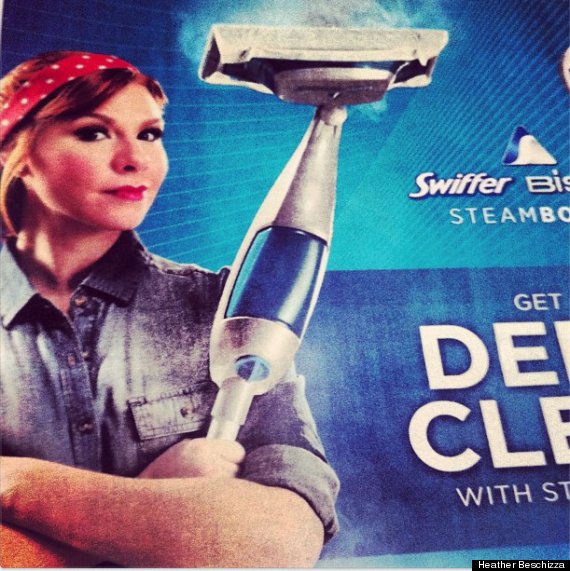
And once again we address Rosie the Riveter remakes and cleaning advertisements. But this time they're mixed together!


ARE YOUR FUCKING KIDDING ME!

Of course this is fucking sexist, as has been noted by other people.  But seriously, how anyone could have missed the sexism (or not cared) and approved this image is beyond me.

Rosie the Riveter was a rallying cry for women to support the Nation during war time.  It was about women entering the work force in new and necessary ways. It was about casting off old gender roles.  It was about more women shouldering new responsibilities with pride and success.

To take all of that and turn it into some cheap knock off about cleaning (traditional women's work) is so fucking sexist and reductive and just a ridiculous understanding of signs and signifiers and art/history that I really cannot fucking believe it!

And please leave suggestions for topics for future posts in the Babe, is this Sexist? Series.  
You can do so by leaving messages here or in the masterpost.
By tweeting us @FemArmRegime #babeisthissexist?
By messaging us on Tumblr or Facebook. 

Sunday, 13 January 2013

Binary Bullshit: The "Feminine" and Feminism

By: Liberate Zealot

A continuation of Femmephobia is Everywhere 

A lot of the time, I hear people discuss gender roles and characteristics, and the culture at large, as some sort of immutable absolute. "This is the way it is, and has been, world without end (amen)".  Which is such bullshit.  Culture undergoes plenty of changes, some vast, some minute, some incredibly quickly, some at a glacial pace.  And just as culture changes so does our understanding of men and women, masculine and feminine and gender roles, characteristics and binaries.

The (Euro-Western Centric) modern gender Binary sets up characteristics as:
Men                                                     Women
Strong                                                   Weak
Active/Aggressive                                   Passive/Submissive
Logical                                                   Emotional
Analytic                                                  Intuitive
Sexual                                                   Chaste
Decisive                                                 Flaky
Genuine                                                 Back-stabbing

And while some of these are very similar to the ideas of previous centuries and various cultures, some of the binary characteristics are the complete opposite of previous centuries.

From the time of the ancient Greeks through the Renaissance women were seen as more "fleshy" and sexual than men.  Women were temptresses  and men needed to stand firm to their lusty ways.  Similarly this was one reason why women needed to be under the control of men, women weren't seen to be able to control themselves or their "baser" impulses. Now of course over the 1700s this began to change, and by the Victorian era there has been a complete reversal, women were the chaste/non-sexual ones who needed to be protected from base men who couldn't control their lust (and thus male relatives needed to protect their women from other men).
In the course of 200 years the European view of sexuality, morality, and self-control of (middle and upper class) white men and women made a complete about face.  Women went from being "fleshy", lusty, of a simpler morality, and in need of outside control to chaste/non-sexual, the moral centers of the family/society, and in charge of not only controlling their own desires and impulsiveness, but those of men as well.  Meanwhile men went from being the more moral and in control of their desires to having almost uncontrollable lusts that women needed to both control and be protected from.

During this same time period the cultural understanding of emotion and logic underwent vast changes. Again from the time of the Greeks through the Renaissance emotion and logic were not seen as binaries, and both were the domain of men. Deep emotion and the purest and deepest of relationships and love were between men.  At times this was considered especially true of warriors (Japan has also had this interpretation of emotion, relationships, and warrior men).  It wasn't until the Enlightenment Period that emotion and logic became fully divorced and binary traits, and the more "undesirable" one, emotion, became a feminine/womanly trait. And when it comes to male friendships and the societal view of their closeness and expression, these underwent a dramatic shift in barely a decade (the trials of Oscar Wilde and increasing awareness of homosexuality and the stigma against same sex relationships had a lot to do with this).

And this doesn't get into the more tangible signifiers of men/women or "masculine" and "feminine". The blue and pink and their gender alignment shift is perhaps one of the better known examples.  Make-up, high heeled shoes, and long hair have by turns been strongly aligned with with different genders (at different times) or been seen as gender neutral.  During times of gender neutrality these things were often related more to class (make-up and high heels for example).  And the Euro/US/Western idea of math as a male discipline and humanities as a female one is decidedly different than the Japanese understanding of gender, math, and literature.

Furthermore the gendering of roles breaks down as soon as the role becomes associated with profit or recognition.  Cooking for the family is considered women's work, but once it comes to a profession chefs are (mostly) men. The becomes even more true when the chef is "high class" and celebrated.  Fashion, especially the buying of it, is seen as a feminine thing, yet the majority of established and recognized designers and photographers are men.

Basically as traits/roles/characteristics gain or lose their societal worth or value they shift between men and women or being "masculine" and "feminine".  The roles, characteristics, and traits are certainly not immutable.  Neither do they (for the most part, exceptions can be made for weak, back-stabbing etc) have any intrinsic value and for the most part were not created FOR or BY the Patriarchy.  Rather the Patriarchy has created the binary and classification of these characteristics, traits, roles.  Patriarchy says women are of less value and so the things the culture values less become "feminine" or the domain of women. And the way to combat this is not through eschewing or dismissing the things that are considered "feminine".  To disdain or look down on things that are "feminine" is simply the continuation of the Patriarchy. This is not to say that women have to take on anything that is considered "feminine" or that women doing "feminine" things is a necessary part of feminism.  Rather, our feminism must include valuing many of the things seen as traditionally "feminine" or for women, even as we seek to dismantle gender roles and the Binary. It's impossible to value women if we do not value any of the things that are seen as belonging to women.
Saturday, 10 March 2012

Sailor Moon: Feminism and Gender

By: g33k and destroy

              For those of you that don’t know, Sailor Moon (known as Bishoujo Senshi Sailor Moon in Japan) is a TV series based on the manga created by Naoko Takeuchi. The story follows Usagi Tsukino (Serena/Bunny in English translations) who transforms into Sailor Moon, defender of love and justice. She is also the Moon Princess, royalty from a now defunct kingdom on the Moon during a time called the ‘Silver Millennium’, where the moon resided over the rest of the planets in our solar system is peaceful harmony. Her allies are soldiers who represent each of the other planets in the Solar System, as well as ex-villains, beings from other dimensions/times as well as her daughter from the future. Sailor Moon is one of the most successful series of all time, being translated, published and broadcast in many countries all over the world. Sailor Moon was an enormous part of my childhood. It wasn’t until I become interested in feminist thought and became more mature that I viewed the franchise with a new appreciation.  I will be focusing on the Sailor Moon television series and later in the year, I will write a follow up criticism of the Sailor Moon manga which is currently being re-released in North America. (Which I purchase religiously bi-monthly.) For now, I will be focusing on Sailor Moon and its elements pertaining to feminism and gender.


              One of my absolutely favourite things about Sailor Moon is the characterization of the female characters as fully-developed and complicated human beings.  The gender of each character is inconsequential to their personality and actions. Each female sailor solider is written as a hero with characteristics and traits which fall within and outside the typical gender boundaries of ‘girls’.  For example, Ami Mizuno (Amy/Sailor Mercury) is often described as the ‘genius girl’, regularly getting the top score in tests and practice entrance exams. She is not just the best among her female peers but among the entire school and even Japan. Ami excels at mathematics, science, and computers; domains which are typically expected to be the speciality of males.  She is even the junior champion of chess. Ami embodies many qualities which are often associated with the ‘masculine’; intelligence, a scientific-mind, analytical, courage, calm and reservation. But she also embodies many other characters which are more typical of the ‘feminine’; modesty, passiveness and compassion. The juxtaposition of these gender characteristics within one female character blurs the concept of what qualities we often associate to males and females.  By presenting all of these traits within one character of a specific gender and sex, the show presents these qualities which are often depicted as heavily segregated between the sexes as traits which both genders readily possess. Another excellent example is Haruko Tenoe (Amara/Sailor Uranus.) Haruko first enters the series dressed as a boy and is thought to be male by both Usagi and Minako. Haruko is very charming and flirtatious but she is also incredibly aggressive. She is confrontational and often engages in physical fights throughout the series. She drives a sports car, a motorcycle and dreams of being a race car driver. While Haruko has many typical ‘masculine’ qualities, she also has typical ‘feminine’ qualities. She is selfless, nurturing, compassionate and incredibly emotional. Each character within the Sailor Moon universe is built of conflicting masculine and feminine traits. Makoto (Lita/Sailor Jupiter) is the physically strongest amongst the original five soldiers and an aggressive tomboy to boot, but she is also an amazing cook, a master of cleaning and a hopeless romantic. Ami, Haruko and Makoto are the strongest examples of characters with stereotypical masculine qualities; however these characters are portrayed as normal, adolescent girls. Within the universe of Sailor Moon, it is normal for these qualities to be seen in women and thus it is never portrayed as strange or exemplary. Sailor Moon puts forward the very modern ideal of feminism, that men and women are the same. Sailor Moon puts forward the idea that one group does not have a preoccupation with certain traits over another. Men and women in this universe commonly embody characteristics from both gender spectrums which we normally assign according to gender.
              Friendship is an enormously important part of the Sailor Moon series, both within the television series and the manga. Friendship is arguably the core theme of the series. The strength of the soldiers comes from their bond with one another and their loved ones. The friendship portrayed in Sailor Moon dispels common social myths about female friendship; women can’t be friend with women and women can’t be friends with men. The friendship between women is often thought of as superficial, shallow and vulnerable. Women will inevitably lie to eachother, talk behind each other’s back, get jealous, have competition and generally be unable to maintain friendships with other women.  If not these factors, women will stop being friends with eachother over a man or another shallow conflict of interest. And of course, women can’t be friends with men, because women and men are only interested in the opposite gender for relationships of various sorts. Sailor Moon portrays female friendship in an incredibly positive light, free of these negative stereotypes. The girls in this series obviously have their conflicts – Arguments, fights, disagreements, competition and at times, jealousy. The difference is that these conflicts are portrayed as normal parts of friendship that just serve to make the relationship stronger. The girls all support and love eachother unconditionally, encouraging eachother in their goals and dreams. There are various times in the series where a man is the object of affection between the girls. Minako and Usagi are competitive over Haruko when they first believe he is a boy. Makoto and Minako are competitive over Motoki. Even Usagi and Rei are competitive over Mamoru for a while, but none of these conflicts destroy or even impact their friendships, as these are their most treasured relationships. The girls are always supportive, honest and trustworthy. It is a great portrayal of female relationships and the important role they can play in the roles of young girls.


              Gender is also an important topic in the universe of Sailor Moon. To be clear, in this section I will be discussing gender, not sex. Gender will be defined as a range of characteristics typically used to distinguish males and females as in feminine and masculine characters. In many ways, the portrayal of gender is very progressive in Sailor Moon. No character only embodies one side of the gender spectrum and all of the characters are very developed as I earlier discussed. Sailor Moon brings an interesting take to the concept of the ‘hero’. Sailor Moon is the most powerful of the soldiers but not because of her physical strength or even supernatural abilities. Her strength comes from her capacity to love others and offer understanding. Most cartoons depict heroes defeating villains with physical strength or superior fighting skills. Sailor Moon draws her strength from her capacity for compassion, a trait which we almost constantly associate with women. To have a cartoon aimed directly at children and young adults that puts forth a female superhero who uses a stereotypical feminine trait to defeat enemies, which is shown to be even stronger than stereotypical masculine traits such as aggression and violence, is a very positive message in my eyes. Sailor Moon is a perfect example of a pacifist superhero. She always seeks peaceful resolutions whenever they are possible. This isn’t to say that she is incapable of defeating a villain outside of her abilities to love; there are times in the series where Sailor Moon must destroy a villain with her supernatural powers. However, she is absolutely in her conviction to find a peaceful resolution before resorting to irreversible decisions regarding life and death.
              This isn’t to say that the soldiers only draw their strength from their capacity to care for one another and their galaxy. The soldiers all excel in different areas of combat. Soldiers like Sailor Saturn and Sailor Pluto have the most amount of power, respectively being the Guardian of Time and the Soldier of Death and Silence. Sailor Mars and Sailor Neptune are both very intuitive individuals who are able to see through illusions and sense the future. Sailor Mars is even able to dispel evil spirits. Sailor Jupiter and Sailor Uranus are the physically strongest amongst the soldiers and excel in various fighting styles. Sailor Venus is the most athletic and Sailor Mercury is the most calculating in her attack strategies. Sailor Moon would not seem nearly as feminist to me if the series put forth the idea that all the girls derive their power from typical female characteristics. The instinct to be protective of others is often thought of as an instinctual male characteristic, as we often associate that males by their very nature protect females. Sailor Moon creates a new universe where girls and women are the ones that step forward to protect the world. The male hero, Tuxedo Mask, is rescued various times throughout the series by Sailor Moon and the soldiers. The series symbolizes that gender is not the final indicator in how you can act and what you are capable of.
              Sailor Moon also teaches valuable lessons on self-acceptance in a variety of areas, from self esteem to sexuality. Mamoru (Tuxedo Mask) is a man who feels personal pain at his inability to remember his past. Haruka (Sailor Uranus) is a girl who dresses in a male school uniform and is often mistaken for a boy. Haruka is also in a romantic relationship with Michiru (Sailor Neptune). These characters are never met with ridicule or hostility. Mamoru is never mocked for his emotional states or judged on his masculinity. Haruka is never judged for her penchant for cross-dressing and neither is her relationship with Michiru.  Additionally, it portrays same-sex relationships between various characters. Haruka and Michiru are the first lesbian couple we meet in the series. They are actually my favourite romantic couple within the entire television series. The romantic scenes we see between Haruka and Michiru are the most imtimate and moving moments we enjoy in the series. Their relationship is arguably portrayed to be the strongest in the entire series. They are a completely committed and loving couple, joined together by not only their feelings but by their dedication to their cause. This was the very first lesbian couple I had ever even learned about as a young girl! Seiya (Sailor Star Fighter) is a Sailor Solider who is a female in his ‘true form’, and she has romantic feelings for Usagi. Kunzite and Zoisite are two male villains within the first season of Sailor Moon in a romantic relationship. The 'Sailor Star Lights' in the fifth and final season of Sailor Moon are female sailor soldiers that transform into men in their civilian identities, which was my very first exposure to the idea of transpeople. Additionally, the villain ‘Fish-Eye’ in season three is portrayed as a homosexual male. Different sexualities and orientations are presented as normal and to be celebrated within the Sailor Moon universe.


              Of course, there are many things I could dissect about Sailor Moon that I feel need improvement. But overall, I think the series sends an overwhelmingly positive message to girls of all ages. Sailor Moon is about self acceptance, self discovery and courage. I used to often wonder how I turned out to be a left-leaning political feminist type, as my parents are generally quite conservative. It wasn’t until I started thinking about all the media I obsessively consumed as a child that I realized that a majority of the shows I watched featured amazing female characters. So really, I feel that I owe Naoko Takeuchi quite a lot of thanks for what she showed me as a young girl.

Monday, 5 March 2012

This Is How It Starts

By: Liberate Zealot

Content Warning: Rape Culture
Part I of Feminism and Children : Feminism and Children MasterPost

I work with children, and the main way I live my feminism is by imparting feminist ideas onto these children.  This means I work to combat their ideas of gender roles and stereotypes, and also by stressing the importance of consent in all interactions.  This generally is an easy thing to explain to children.  Make sure they understand to always ask before touching people (even with friends and nice touches like hugs), that it's alright to say "no" or "not right now", and to respect it when other people say "no" to them.

But sometimes this isn't enough.  Society as a whole doesn't teach these things to kids, in fact, for some of them it teaches the exact opposite.

Tuesday, 14 February 2012

Problems with Valentine's Day

By: Liberate Zealot

Content Warning: stalking, rape culture

I love dressing up, chocolate, good food, romance novels, wine and other romantic things, so you'd think I'd be all over Valentine's Day.  So not the case.  Valentine's Day is not just "not for me", I have major objections to the method and meaning of the whole day.

The accouterments of Valentine's are problematic.  Chocolate is often produced in slave like conditions by child workers.  Flowers are grown in South America where women work for limited pay and in unsafe conditions.  Then there's the prevalence of blood diamonds that make jewelry shopping ethically difficult. But, there are Fair Trade options, so this alone is not enough to ruin Valentine's Day for me.

However, there's also the problem with Grand Romantic Gestures and the stories around them.  One day of romance, one grand gesture, isn't enough to make a good relationship.  It's the everyday caring, support, and love that matters (and that Valentine's Day fails to celebrate).  I don't like the idea that if you don't do something dramatic on this one day then you're a bad partner (partially because there's a certain amount of classism involved, though that exists with every material driven holiday).   And then there's the stalking aspect of grand romance, which some people really went with this year.